Chapter 43: The Virtual Code Fallacy
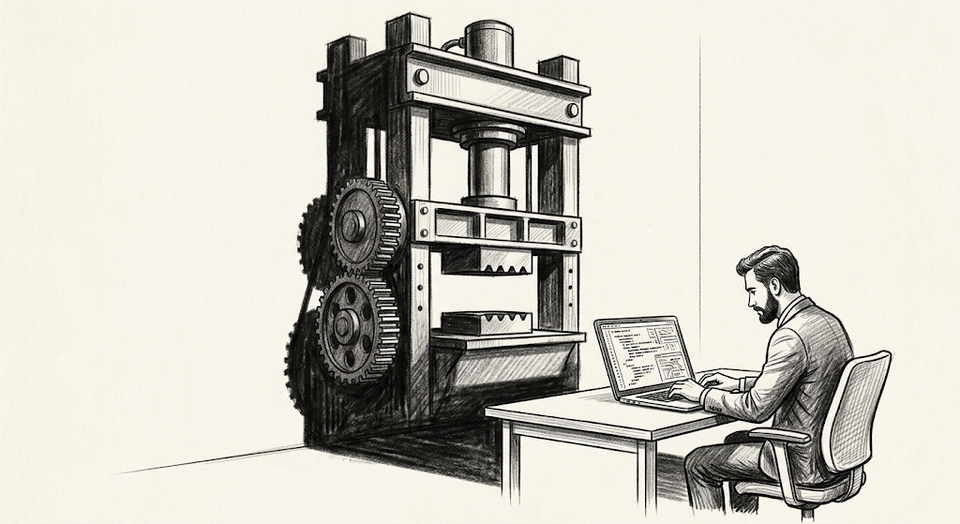
The Kinetic Force of Code
Early in my career I worked as an industrial automation engineer. My cycle began with blueprints and site visits to heavy manufacturing plants. We built CAD models, wrote controller logic in specialized IDEs, wired physical electrical cabinets, and loaded code into PLCs. Then came the moment of truth: Commissioning.
You connected high-voltage power cables, field sensors, and hydraulic actuators, and you stepped back.
My first assignment was writing control logic for a semi-dry industrial press. On my laptop’s software emulator, everything was flawless: timing pulses fired, output bits flipped, logic gates closed smoothly. Then I stood in the factory floor next to the actual machine: a six-meter-tall steel monolith controlled entirely by my code.
Once a minute, the press cycled. BANG! The concrete foundation under my boots literally jumped. After three cycles, I shut everything down and spent hours re-checking my logic for the 50th time. It was terrifying, exhilarating, and undeniably real.
Over the years, commissioning meant running lines at -15 C in unheated sheds, enduring +50 C heat in the Kazakh steppe, navigating the intoxicating fumes of vodka distilleries, and shouting over the deafening roar of pipe-cutting mills.
In industrial automation, code was never an abstraction. Code was kinetic energy, noise, heat, and physical risk.
The "Plastic" World of Abstract Web Development
When I transitioned into web and cloud software, I entered a world of offshore clients, remote sign-offs, and screen-only interactions. For the first six months, I was haunted by a feeling of artificiality—a sense that everything was made of plastic.
As I began managing developers who had spent their entire careers in web agencies or straight out of university, I noticed a widespread phenomenon: The Virtual Code Disconnect.
To a developer who has never interacted with the physical domain of their software, code is merely an exercise in applied mathematics and syntax:
Database -> ORM Model -> State -> DOM Rendering
They do not see a human being trying to buy medicine or a warehouse worker trying to locate a pallet. They see an abstract data pipeline. To them, displaying an e-commerce shopping cart looks identical to rendering an alert for a failing conveyor belt, a mortality statistic dashboard, or a chicken incubator controller. It is all just JSON payloads and database rows.
The Loss of Visceral Purpose
When a pipe-cutting line roars to life and runs continuously for 72 hours without human intervention, the engineering team experiences a deep, primal satisfaction. You built something that operates in the real world.
In abstract software, that tangible feedback loop is broken. Developers get:
- A incrementing counter in Google Analytics
- A database row count changing from 0 to 1
- A generic Slack message from a distant stakeholder
Without physical feedback, work degrades into ticket-churning. When engineers cannot visualize the human operating their software, quality drops, edge cases are ignored, and empathy vanishes.
The Manager’s Duty: Grounding Code in Reality
It is the primary responsibility of a manager to smash the virtual wall and reconnect the team with the physical reality of their product:
- Inject Raw User Artifacts: Show videos of actual operators using the interface in their real environments (noisy warehouses, glaring sunlight, spotty cellular connections).
- Bring the Floor to the Office: Organize site visits, bring end-users into sprint reviews, or record raw, unedited user interviews.
- Frame Bugs in Terms of Human Friction: Never discuss an error rate as a mere percentage. Frame it as "50 warehouse workers stood idle for 12 minutes today because the scanner timed out."
When developers realize their code is not just "virtual text," but a lever that directly impacts a living person's day, two things happen: quality skyrockets, and the team rediscovers genuine pride in their craft.