From Heavy Machinery to AI Steering
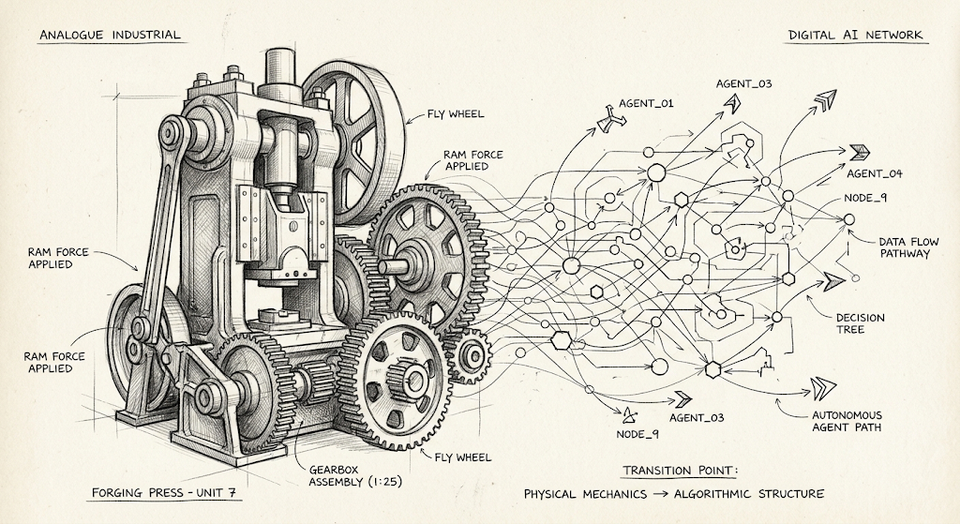
My name is Constantin Makeev. In 2005, I graduated from the National Aerospace University "Kharkiv Aviation Institute" with a degree in Computer Science - trained as a hybrid engineer writing software for aircraft designers. My career began in the physical world: programming PLCs and HMIs for heavy industrial automation systems. If you have ever stood next to a 6-meter-tall industrial press executing your code, you quickly develop a deep respect for edge cases and systemic risk.
From industrial automation, I transitioned into web software development. Driven by a desire to shape systems larger than individual IDEs, I took the slippery slope into management, eventually serving as Delivery Director for a global software firm, scaling technical orgs from 3 to 150 FTEs and overseeing portfolios of up to 40 parallel projects.
As the scale grew, pure execution was no longer enough. I realized that managing projects is useless if you are building the wrong things. That realization led me to the Executive MBA program at Warwick Business School, where I graduated with distinction in 2021. The MBA recalibrated my mental models: shifting my focus from purely “doing things right” (engineering delivery) to “doing the right things” (product strategy, unit economics, and P&L ownership).
Over the past years, I have plunged headfirst into the frontier of product execution: building end-to-end platforms using multi-agent AI orchestration, Retrieval-Augmented Generation (RAG), structured harness guidelines, and human-in-the-loop quality gates.
This playbook exists to pass on those battle-tested lessons. You will not find dry, academic process definitions or PMBOK dogma here. Instead, this is a field guide built on real scars: broken teams, missed deadlines, failed product launches, and hard-fought organizational pivots. Whether you are a 25-year-old new team lead or a 50-year-old veteran engineer stepping into people management for the first time, this site is designed to give you instant leverage when your old mental models stop working.
Let's walk this path together.
The Master Backlog (Living Table of Contents)
Below is the complete roadmap for PM Hints. As chapters are published, they will become active links below.
Part I: The Human Shift - From Syntax to People.
- The Binary Trap: Moving from Boolean Determinism to Human Systems.
- Real-Life Patterns of Leadership: Reusing Everyday Skills to Run High-Performing Teams.
- The Balance Guideline: Managing expectations, establishing trust, and protecting the team without trying to be a "$100 bill" pleasing everyone.
- Selling Ideas: The art of convincing without authority.
Part II: Client Mechanics - Harnessing a Superpower.
- Stakeholder Topology: Mapping Human Risk Vectors and Navigating Client Dynamics.
- The Client Isn't Always Right, But They Sign the Checks: Navigating Technical Pushback, Urgent Cascades, and the Anchoring Trap.
- Urgency Cascades & Risk Governance: Managing Delivery Variance, Buffer Discipline, and the Anchoring Trap.
- Response Latency & Asynchronous Delivery: Managing client communication like software UI latency.
- The "Smooth Lawn" Reporting Dilemma: Radical Transparency, Strategic Shielding, and the Architecture of Client Trust.
- The Client as a Core Team Member: Shifting Business Ownership, Building a Shared Vocabulary, and Elevating Client Literacy.
Part III: Team Dynamics - How to Nurture Winning Teams.
- The Instrument of Delivery: Respect, Maintenance, and Boundaries in Team Governance.
- Internal Transparency & Mutual Trust: Layered Mental Models, the Submarine Gradient, and Default Trust.
- Delivery Cadence & Controlled Overtime: Establishing Systemic Rhythm, Avoiding the Infinite Swamp, and Leveraging Tactical Crunch.
- The Mechanics of Motivation: McGregor’s Spectrum, Herzberg’s Baseline, and Managing Knowledge Work.
- The "Milk-Can" Anti-Pattern: Unreflective Execution, Psychological Safety, and Malicious Compliance.
- Zero-Sum Hoarding & Cross-Team Generosity: Resource Sharing, Organizational Reciprocity, and Hard Commitment Boundaries.
- Non-Linear Systems & Headcount Math: Onboarding Friction, Systemic Drag, and the Fallacy of Junior Equivalence.
- Graceful Offboarding & The Open Door: Diagnosing Departure Motives, Avoiding Heavy-Handed Retention, and Managing Voluntary Turnover.
- Incident Response & Calibrated Transparency: Extracting Value from Failure, The Mentorship Buffer, and The Client Shield.
- Burn, But Do Not Burn Out: Managing Professional Depletion, Emotional Shielding, and Sustainable Leadership.
- Builders, Auditors, and Systemic Quality: Delivery Ethics, and the Art of the Postman.
- Personal Relationships at Work: The Nepotism Trap and the Functional Tool Principle.
Part IV: Process Design – Nudging the Project.
- Sourcing & Screening: The Carpenter’s Workbench and Fast Decisions.
- Onboarding Mechanics: Workspace Physics, Pre-Provisioning, and the Day-One Checklist.
- The Art of Delegation: Why Centralized Control Crushes System Scale.
- Project Documentation: Classic vs Agile Approach.
- The Mechanics of Timing: Situational Awareness and Reading the Room to Sell Ideas.
- Communication Channels: Matching Message Urgency to the Right Pipeline.
- Tooling is Not Enough: Pragmatic Automation and the Shiny Object Trap.
- Toxic Environments: People Dynamics, Clans, and Clean Separations.
- Toxic Infrastructure: Tools Over Status and Physical Ergonomics.
- Process Alignment: The Art of Pipeline Ownership, Bypassing Blockers, and Driving the Machine.
- Tactical Courage: Calculated Risk, Log-rolloing, and the Stockdale Paradox.
- Productive Laziness: The Theater of Activity, Systemic Simplification, and Outcome-Based Evaluation.
- Multi-Dimensional Tetris: Resource Allocation, Career Trajectories, and Solving Multiple Bottlenecks at Once.
- Estimation Mechanics: The Gauge for Team, Client, and Process.
Part V: Human Capability – Sharpen the Bright Minds.
- The Growth Imperative: Why single-point master craftsmen endanger the business (The Харьков Aircraft Factory lesson).
- Pacing Skill Acquisition: "Driving on Sand" (Balancing difficulty between boredom and burnout).
- The Socratic Sandbox: Asking questions instead of supplying answers; letting juniors make non-fatal mistakes.
- Methodology Cookbooks: Treating books/frameworks as recipe catalogs rather than rigid dogmas.
- Risk as a Training Ground: Using low-risk projects as live-fire sandboxes for junior advancement.
- Language & Mental Models: Stripping jargon, using simple analogies, and Einstein’s grandmother test.
- Resource Reshuffling ("Multi-Dimensional 15-Puzzle"): Balancing project re-assignments with individual career trajectories.
- The Formula for Mastery: Willpower, skills, pain, and luck (The Fort Minor blueprint).
Part VI: The Commercial Shift - From Custom Dev to Product Mindset.
- Bumping Hours vs. Building Defensibility: The business lens -transitioning from agency/outsourcing delivery to unit economics, B2B customer journeys, and platform ownership.
- Bridging Business and Architecture: Translating executive strategy into engineering requirements without getting lost in stack wars or chasing the myth of a "100% frozen specification" in a dynamic system.
- Heuristic Bias & "Common Sense": Why "common sense" does not exist and why asking your girlfriend what she wants to order won't save your share of the steak.
Part VII: The AI Shift - From Toil to System Steering.
- The Syntax Fallacy: Why suffering through dependency hell, broken builds, and line-by-line debugging isn't true engineering - it's low-leverage toil.
- Multi-Agent System Steering: Operating as CTO and Quality Lead through dual-agent orchestration, Spec-Kit workflows, and human-in-the-loop quality gates.
- Requirements-to-Specs Velocity: Accelerating delivery pipelines by using AI work surfaces to direct, verify, and ship enterprise features.
Part VIII: Looking into the Future - Sustainable Talent & AI Realities.
- The Potato Seeding Fallacy: Why demanding "day-one ROI" from junior developers via AI code generation destroys foundational engineering mental models.
- The Pilot Crisis in Tech: Why cutting off junior hiring and relying purely on synthetic output creates a catastrophic future shortage of true system architects.
- Generational Tools vs. Ultimate Value: Rethinking mentorship—new engineers won't need to hunt for missing semicolons in a wall of source code any more than my generation needed library card catalogs after Google. Delivering value remains the ultimate measure of your outcome.