Chapter 54: The Change Blueprint for the AI Era
The First Axiom of AI Change
Recall the fundamental rule of organizational transformation from Chapter 37: The only person who genuinely welcomes change is a baby with a dirty diaper.
When an Engineering Manager announces that the team must abandon "vibe coding" in favor of strict Harness-Driven Development—requiring written specs, explicit boundaries, and context-loading rules—senior engineers will instinctively rebel. They view formalization as bureaucracy, arguing that writing boundary contracts wastes time compared to typing quick prompts directly into a chat window.
Forcing transformation through decrees or corporate cheerleading guarantees passive sabotage. To transition a team from alchemical prompt-throwing to systematic Harness discipline, execute the 6-step change management blueprint calibrated to technical realities.
Step 0: The Executive Mandate & Burning the Backdoors
Before launching change initiatives, secure top-level legitimacy and eliminate operational escape routes.
Instead of prescribing specific tooling, executive leadership issues a strict OKR directly to the Chief Technology Officer:
- Objective: Eliminate unconstrained synthetic code execution across all production pipelines.
- Key Result: 0% of merged pull requests or deployed modules bypass defined Harness guardrails.
The exact implementation—whether enforced through CI/CD pre-commit gates, automated Spec-Kit validation, or repository access policies—is left entirely to the CTO's technical authority. By burning the backdoors, "vibe coding" directly into production repositories ceases to exist as an operational alternative.
Step 1: Proving Cost of Inaction Through Controlled Failure (The Crash Test)
You cannot persuade skeptical senior engineers with slide decks or corporate memos. You persuade them through a controlled crash test.
The goal of this exercise is not to break a senior's morale or prompt a career crisis, but to demonstrate the undeniable utility of an engineering "seatbelt." Before the test begins, pre-brief the engineer: explicitly explain the mechanics of Harness-Driven Development, present the guidelines, and outline the operational risks of unconstrained execution.
Then, place them inside a safe, isolated test track—a non-critical sandbox repository with zero production or delivery risk. Grant them total freedom to execute unconstrained "vibe coding" prompts without written specs or boundary contracts.
Like a test driver hitting a water barrel at 30 km/h on a closed track, the senior will experience a sudden, non-lethal impact. Within 24 to 48 hours, as they attempt a simple system refactor, the AI agent will flood the pull request with thousands of lines of unmaintainable code slop, subtle API hallucinations, and broken paradigms.
Rubbing the metaphorical bump on their forehead after spending hours picking apart synthetic garbage by hand, the senior experiences the true Cost of Inaction. The temporary friction of writing a 10-minute Harness contract suddenly transforms into a welcome, non-negotiable seatbelt.
Step 2: The Fire-Filled Coalition
Form an advance coalition of respected practitioners—not corporate cheerleaders, but pragmatists who understand the pain of reviewer fatigue. Include representatives across backend, frontend, DevOps, and QA.
This coalition becomes the primary testing ground for your initial Harness templates, testing context boundaries on real-world tickets before broad rollout.
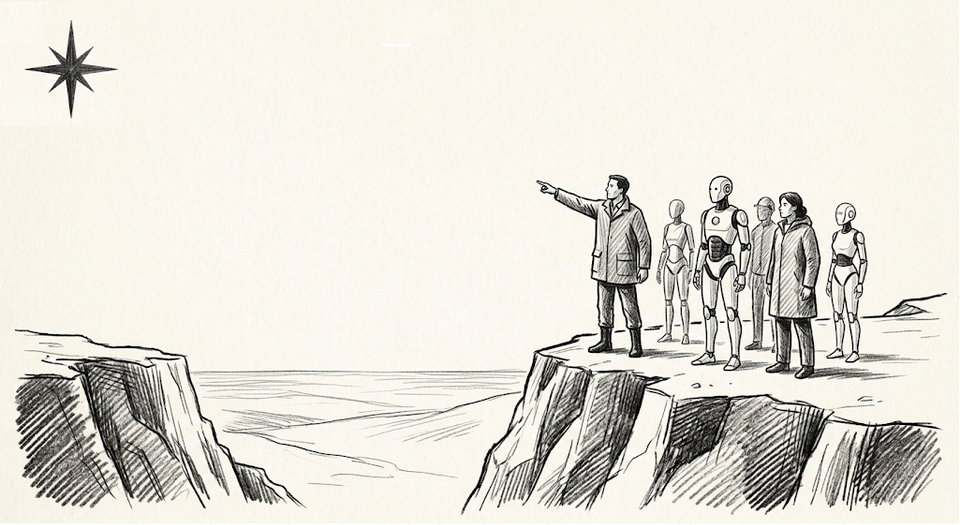
Step 3: The North Star Vision
Define a transparent operational horizon:
"Our goal is not to write code faster; our goal is to eliminate manual syntax toil entirely so engineers operate exclusively as Systemic Navigators within automated, zero-trust Sandboxes."
The North Star sets the destination; tactical flexibility handles the terrain.
Step 4: Engineering Quick Wins via Design Thinking
Execute 90-day improvement loops using Silent Problem Mapping:
- Have the coalition silently map the friction points of AI integration (e.g., "agents keep using deprecated internal APIs", "generated tests lack mock fixtures").
- Quantify each pain point by severity and estimated fix effort.
- Prioritize quick wins where Efficiency = Pain Severity / Effort.
Fixing a major friction point—such as creating a standardized internal API Harness that stops LLMs from hallucinating outdated methods—delivers immediate, undeniable relief to the team within weeks.
Step 5 & 6: Viral Ownership and the Iterative Loop
When the coalition achieves a quick win, broadcast the metrics across the engineering organization: demonstrate how cycle time dropped while reviewer fatigue plummeted.
Because the engineers built the Harness templates themselves, ownership spreads virally through peer advocacy rather than management memos. Converted skeptics—fresh off their controlled crash-test experiences—will voluntarily join the coalition to write guardrails for their own sub-domains.
Repeat the 90-day loop. Adaptability turns from a painful corporate initiative into the team’s default muscle memory.