Chapter 01: The Binary Trap
The Illusion of Control
When a top-performing software engineer is promoted to lead a team, executive leadership usually assumes technical mastery will translate directly into operational management. Then reality hits: tasks are delivered late, misaligned with specifications, or built in completely unexpected ways. The first-time manager experiences a sudden, disorienting loss of control.
In software development, you interact with a deterministic system. Code executes exactly as written. You can insult a server or spit on the monitor in frustration, and the compiler will still evaluate your logic without bias, fatigue, or resentment.
Human beings operate on fundamentally different principles. Every engineer on your team introduces creative and behavioral variance based on memory, context, and emotional state:
- Unconscious Heuristics: Walking up three flights of stairs every morning out of habit, completely oblivious to the elevator right next to the entrance.
- Misguided Optimization: Adding a kilogram of sugar instead of 100 grams to a recipe, sincerely believing it will make it ten times tastier.
- Emotional Distortion: Bad traffic, a personal argument, or morning frustration quietly warping a developer's focus and logic.
- Literal Interpretation: Frying unwashed, unpeeled potatoes because the spec said "fry potatoes" and didn't explicitly mandate washing or peeling them.
Machine code cannot adapt, improvise, or innovate on its own—but it also doesn't forget or hold a grudge. Transitioning to leadership requires recognizing that human variability isn't a bug to be patched; it is the core system environment you must manage.
The Boolean Fallacy
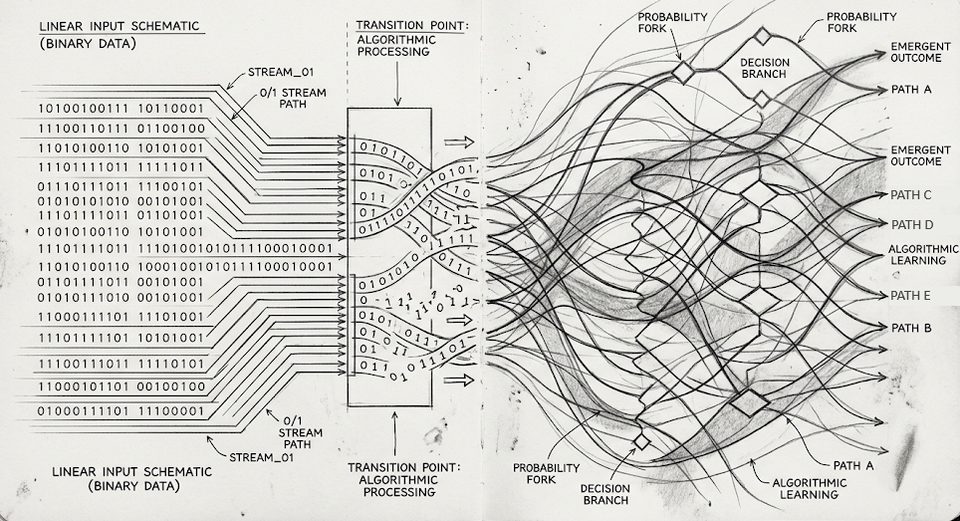
Engineers spend years conditioned by binary architecture: $0/1$, True/False, Black/White. When stepping into leadership, the default instinct is to reduce every organizational problem to boolean logic.
This mental model breaks down immediately. Neither software developers nor enterprise clients accept polar, binary solutions to complex problems. For a deterministic engineer, the most disorienting realization is the complete absence of a single "correct" answer.
Your management vocabulary must expand beyond binary outputs to incorporate conditional states: "Maybe," "Promising," or "Profitable under specific constraints."Even project results lose their binary simplicity—a finished and delivered project isn't automatically a win, and a canceled project isn't inherently a defeat.
When leads try to force absolute binary predictability onto this ambiguity, they often retreat into process dogma. Project management methodologies cease to be practical tools and turn into rigid religions, with leads fighting over metric compliance while ignoring human realities.
The System Upgrade
Stepping into management does not require abandoning logical rigor. It requires upgrading your mental models from single-threaded, deterministic scripts to high-dimensional probabilistic systems.
Truth inside an organization is rarely absolute; every stakeholder, developer, and client operates on their own valid perspective and incentives. The manager’s true role is not to act as a rigid compiler enforcing single-line syntax, but to reconcile competing perspectives, establish operational balance, and steer disparate human vectors toward a shared commercial outcome.