Chapter 02: Real-Life Patterns of Leadership
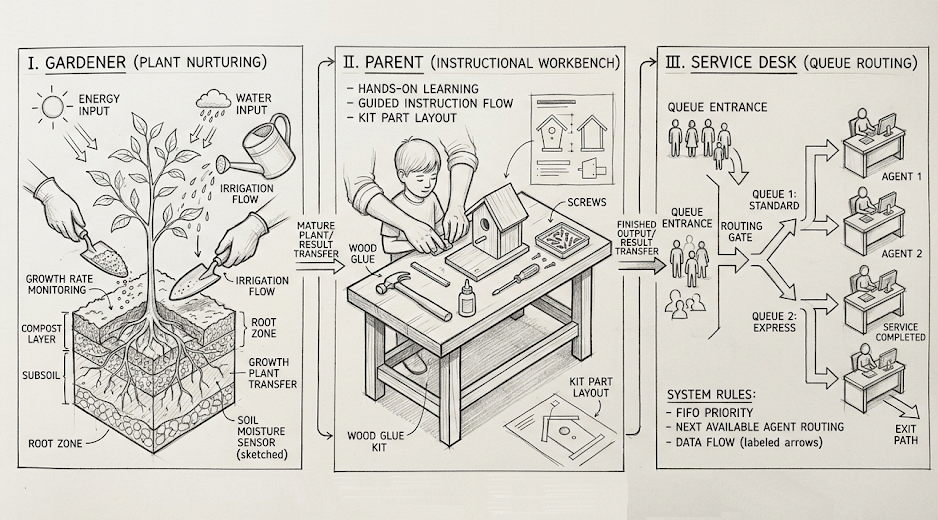
The Pattern-Reuse Advantage
When brilliant technical specialists step into management, organizations often lose a top engineer and gain a mediocre lead who burns through talent while searching for complex management frameworks. Effective engineering leadership isn't an abstract science — it is the direct application of real-life human skills you already possess.
When managing a project and building a pod, a lead executes the exact same core functions a parent uses while raising children, a gardener uses to manage an ecosystem, and a plant manager uses to run an assembly line. Reusing this everyday muscle memory removes the fear of the unknown: you are not learning a foreign discipline, but applying known human patterns to complex technical systems.
Pattern 1: The Parent (Human System Mechanics)
Leadership inside an engineering pod mirrors the developmental mechanics of raising children: Understanding, Educating, Monitoring, Praising, Disciplining, Unlocking Individuality, and Supporting.
1. Understanding: Reading Telemetry and Unspoken Signals
Before you judge performance or take corrective action, you must evaluate the human state driving it. Engineers, like children, communicate through distinct signal systems and specialized sub-languages.
- Extroverts: Trivial to read. When happy, they beam like a Christmas tree; when worried, they freeze up; when upset, they look gloomier than the apocalypse.
- Introverts: The real operational risk. To an introvert, everything is always "fine." They maintain a deadpan poker face even as their code base—or personal life—is collapsing around them.
A lead must actively read behavioral cues and catch subconscious slips. Spotting an engineer's emotional distortion or burnout in its early stages allows simple intervention; fixing a burnt-out engineer after a catastrophic systemic explosion is nearly impossible.
2. Educating: Building Independent Systems
Teaching is not micromanaging daily tasks. It is conveying how the world works, establishing cause-and-effect chains, and instilling the ability to learn independently while filtering out terabytes of digital noise.
Your goal as a lead is to build a reliable platform, demonstrate the systemic rules of the architecture, and get out of the way. Once an inquisitive engineering mind understands the system boundaries, it will pave its own path.
3. Monitoring: Explicit vs. Implicit Control
Control simply means checking current reality against your planned delivery trajectory. However, the mode of control dictates team stress and delivery velocity:
- Explicit Control (The Sword of Damocles): Constant, overt pressure. While effective in acute crises, it carries two fatal flaws: the moment oversight is removed, execution quality collapses, and smart engineers will spend all their creative energy figuring out how to bypass the supervisor.
- Implicit Control (Background Telemetry): Subtle, non-intrusive monitoring used during steady-state operations. It gathers telemetry and tracks progress without creating the oppressive atmosphere of a panopticon.
4. Praising & Disciplining: The Feedback Protocol
Gathering metrics is useless if you cannot alter behavior. Feedback must adhere to four non-negotiable rules:
- Feedback is Mandatory: Never ignore a mistake, and never forget to praise an achievement. Withholding praise destroys future initiative; ignoring bad execution signals that mediocrity is the team standard.
- Proportionality: Do not cut off a finger because an engineer failed to greet a client properly.
- Timeliness: Feedback must happen as close to the event as possible. However, if an engineer is actively putting out a production fire under tight deadlines, support them first—hold the retrospective debrief only after the storm passes.
- Public vs. Private: Praise in public; discipline in private.
5. Unlocking Individuality: Talent Routing
A child who screams loudly with a great sense of rhythm might be a nightmare for quiet neighbors, or they might become a world-class opera singer. A child jumping off furniture is either a domestic hazard or a future Olympic gymnast.
In engineering, a developer who struggles to write clear client emails but effortlessly holds the entire class hierarchy of the .NET Framework in their head is an HR headache if mismanaged—or your best system architect if positioned correctly. People are not uniform, interchangeable bricks. A lead's job is to identify individual quirks, neutralize weaknesses, and place each uniquely shaped puzzle piece where it delivers maximum impact.
6. Supporting: Standing in the Corner Together
When an engineer manages to bring down a production system for 30 minutes at peak load, discipline is secondary. The primary issue is systemic: why did the environment allow a single unverified command to touch state without a stage-gate?
If your engineer failed, you failed as well—you failed to build proper guardrails, enforce reviews, or isolate critical infrastructure. Stand in the corner together, hold each other close, and cry your eyes out. Help them survive the crisis without breaking their spirit, analyze the root cause together, and build a resilient system. The loyalty forged by standing by your people during a crisis pays off a hundredfold.
Structural Boundaries
While the psychological mechanics match parenting, two hard operational boundaries separate the roles:
- Time Horizon: Parents have two decades to shape a child's worldview. A lead receives adults with fixed mindsets and established habits; you can nudge behavior and align incentives, but you cannot rewrite fundamental character.
- Blood Ties vs. Contracts: Parents are bound for life. A lead who has exhausted every avenue of mentoring, training, and boundary-setting must retain the operational discipline to fire an unaligned employee for the health of the pod.
Pattern 2: The Gardener (Managing External Volatility)
Unlike a programmer writing deterministic code, a gardener cannot force a plant to grow faster by pulling on its leaves. A gardener manages the surrounding ecosystem: weather, drought, pest migration, soil quality, and fertilizers.
In engineering leadership, your project’s success depends heavily on external, non-technical variables: company politics, shifting client budgets, changing product priorities, investor funding, and stack choices.
You do not control the weather. Based on experience, books, and project constraints, you must make non-trivial decisions to shield the team from external storms, supply the right nutrients, and calculate risk steps ahead—or hope you are lucky enough to rub a lucky rabbit's foot at the right moment.
Pattern 3: The Assembly Line & Service Desk (Operational Throughput)
If you step into management expecting a crown, a throne, and quiet days spent contemplating software architecture in the Garden of Eden, reality will hit hard. A manager spends most of their day operating as a high-frequency psychological service desk handling constant cries of "Houston, we have a problem!"
Your primary job is maintaining continuous throughput on the production line:
- Intake Filtering: Raw client requirements are dirty. They must pass through a filter (such as a Business Analyst) to scrub impurities before hitting your developers.
- Tooling & Maintenance: Developers are your high-output CNC machine tools. Pushing them at redline capacity continuously causes them to burn out. They require scheduled maintenance: time off, CNC CPU firmware updates at tech conferences, and replacing worn cutting tools with modern IDEs and workstations.
- Capital & Fuel Allocation: High-capacity machinery consumes more fuel (client capital). However, overfilling an engine starves it of oxygen (grounded reality and market accountability) and stalls the motor—funding must match execution capacity.
- Line Balancing:
- All Juniors: The line lacks the power to process complex requirements into architecture, producing a fragile product that crumbles on its first or second use.
- All Seniors: Fuel burn skyrockets, exhausting the budget before shipping—the operational equivalent of using a multi-ton industrial press to fold matchboxes.
- Managing Operational Variables: Every machine tool on the line has a personality. On any given day, an engineer might be dealing with personal troubles, recovering from a hangover, or reeling from an argument with their spouse.
Every engineer on your team moves along an individual directional vector driven by personal ambition, habits, and mood. Your core responsibility as a lead is summing those individual vectors so the total team trajectory lands precisely where the commercial outcome requires.