Chapter 05: Stakeholder Topology
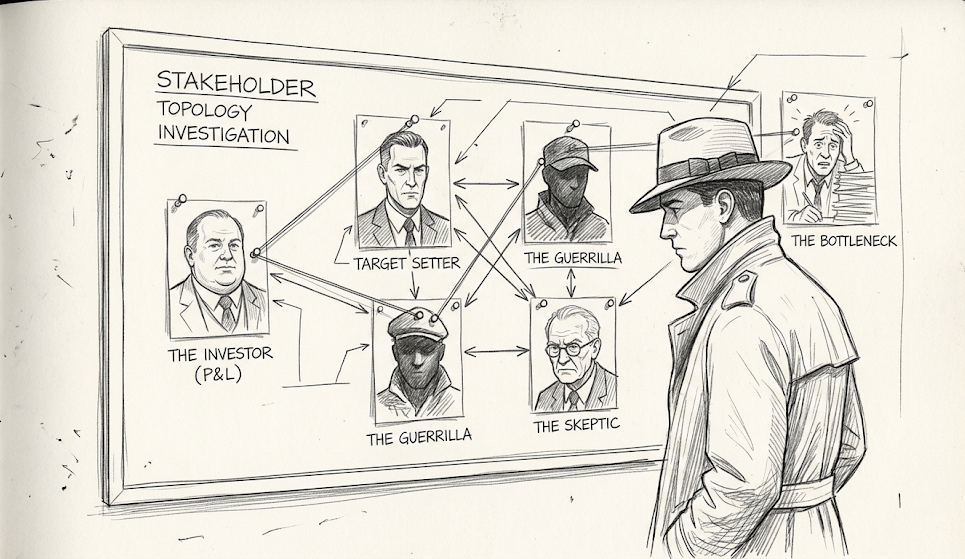
The Client Reality Check
Regardless of corporate rhetoric, the client remains the single most critical vector in any commercial engagement. Work is fundamentally an energy transformation: converting technical skill, domain knowledge, and time into a finished product. That product must serve the entity paying the bills—whether that entity is an enterprise C-suite, a customer cooking soup at home, or a toddler running around in diapers.
Pepole who claim they "only work for themselves" are either misinformed, self-deceived, or pursuing a hobby. Unless your personal needs perfectly mirror market demand, you are fulfilling someone else's requirements. In commercial delivery, two client archetypes exist:
- The Direct Buyer (Services & B2B): The external sponsor who receives invoices and directly funds delivery.
- The Proxy Buyer (Product Development): The internal market proxies—Product Management and Marketing—who dictate features and design on behalf of an abstract user base.
Step zero for any project manager is mapping the human topology behind these client structures. Failing to identify who actually holds power across your stakeholder map is the fastest way to derail a project.
Stakeholder Role Mapping
Stakeholders rarely fit into neat organizational chart boxes. To navigate enterprise politics, you must map individuals to five core operational roles:
1. The Target Setter (Scope Owner)
The individual defining requirements, setting iteration priorities, and dictating completion dates.
2. The Investor (P&L Holder)
The sponsor controlling budget releases and signing off on invoices.
3. The End User
The operational actor who actually uses the finished software.
4. The Adversary (Organizational Risk Vector)
An influential stakeholder actively working against project momentum. Adversaries are rarely evil; they are usually protecting territory, dreading post-launch re-skilling, or defending colleagues displaced by automation. They operate through four distinct behavioral patterns:
- The Guerrilla: Publicly nods along in every steering committee, appearing completely passive. As launch approaches, they trigger guerilla fires—discovering alternative vendors, attacking implementation choices, or criticizing UX. Crucially, they never escalate to you directly; they whisper complaints straight to the Investor or End User, forcing you to waste days on reputation damage control.
- The Skeptic: Actively attacks your architectural proposals, team staffing, and timelines. Skeptics are often battle-scarred veterans who have survived previous failed rollouts. If you systematically address their technical concerns with facts, a Skeptic can be converted into your strongest Ally.
- The Bottleneck: Sabotages velocity through weaponized inertia. They spend three weeks reviewing a three-page specification or take two months to provision a simple staging database. Buffer their structural slowness by issuing dependencies far ahead of delivery dates.
- The Time Vampire: Hijacks your schedule under the guise of "critical project alignment," only to pivot into 90-minute rants about personal grievances, global ecology, or Middle Eastern geopolitics. Politely cut these conversations short—every minute spent entertaining a Time Vampire is stolen from delivery throughput.
5. The Ally
Stakeholders whose incentives align with yours—whether through direct P&L bonuses, personal relationships, or corporate politics ("the enemy of my enemy").
- Situational vs. Permanent Allies: Exercise extreme caution with situational allies. The moment organizational political currents shift, a situational ally will leverage internal project details against you.
- Protecting Allies: Never publicly parade an internal ally as your mouthpiece. If the client organization perceives them as a vendor puppet, their internal political influence collapses.
Role Overlap & The Target Setter Risk
One stakeholder often plays multiple roles, and the ideal alignment occurs when the Target Setter and Investor are the same person.
If these roles are split, you must immediately determine the Target Setter's true level of accountability. When a Target Setter carries zero financial or business risk for their scope decisions, a slick operator will dodge responsibility and scapegoat the project manager and team the moment the Investor is dissatisfied with the end product.