Chapter 10: The Client as a Core Team Member
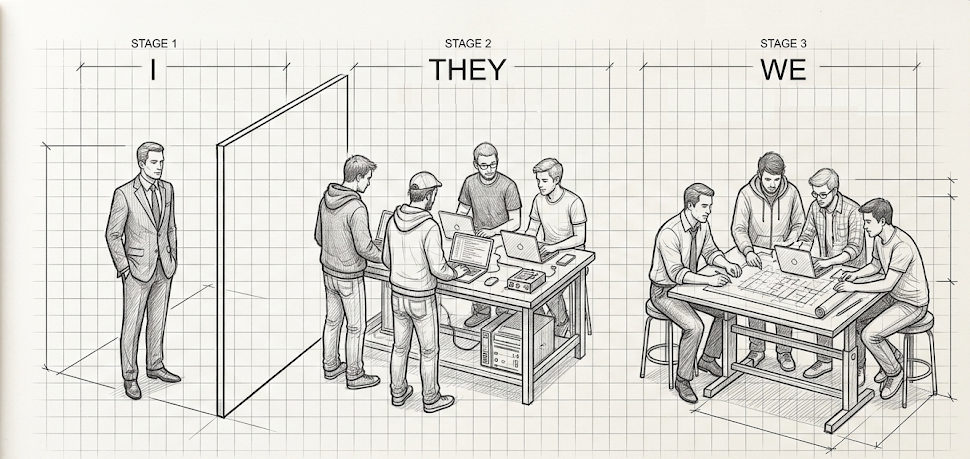
The Passive Buyer Illusion
Without a client, a project cannot exist. At its core, every initiative begins with a specific individual who has a real-world business problem that needs solving—meaning, first and foremost, the outcome matters to them. You must never forget this fundamental leverage.
Clients often assume that once they contract an engineering firm, their personal involvement is complete. Allowing this mindset to persist is fatal.
You must systematically condition the client to realize that the product is their brainchild. Its market success or failure rests on their shoulders; the development team is merely the precision instrument used to build it. To wield an engineering team effectively, the client must actively invest effort into the project and into their own role within it.
Separating Business Trade-Offs from Technical Execution
Establishing a sharp boundary between business decisions and technical execution is the first step toward genuine integration:
- The Team Owns Technical Execution: Determining HOW to architect the system and HOW MUCH effort it requires.
- The Client Owns Business Trade-Offs: Defining WHAT brings value to their domain and BY WHEN it must ship.
The engineering team cannot make commercial trade-offs on the client's behalf. Deciding which features are vital to market survival and which can be cut rests entirely with the client. The faster and more decisively they take ownership of these choices, the faster and more cost-effectively the team can deliver.
Developing a Shared Domain Context
As a project progresses, developers naturally immerse themselves in the client's business domain. They learn the industry terminology, analyze operational constraints, grasp market drivers, and understand the client's competitive landscape.
This deep context makes the engineering team exponentially more valuable over time. As daily operational friction dissolves, both sides begin speaking a unified language, cutting through misunderstandings with minimal effort.
The Power of Continuous Client Education
Domain adaptation cannot be a one-way street. A critical, often overlooked multiplier of project success is actively educating the client.
Whenever you negotiate architectural choices, set technical priorities, or reallocate engineers within the team, take the time to explain the rationale behind your moves:
- Demystify the Rationale: Explain why a specific technical debt refactor is necessary or how a team shift preserves velocity.
- Elevate Technical Literacy: Gradually raise the client's understanding of software delivery mechanics.
- Build Long-Term Alignment: A technically literate client stops viewing engineering as magic, respects architectural constraints, and makes smarter business calls.
Client education is an ongoing, high-leverage process. When a client understands how the machine works under the hood, they cease to be an external adversary pushing unrealistic demands—they become a trusted, capable member of the core delivery team.