Chapter 26: Project Documentation
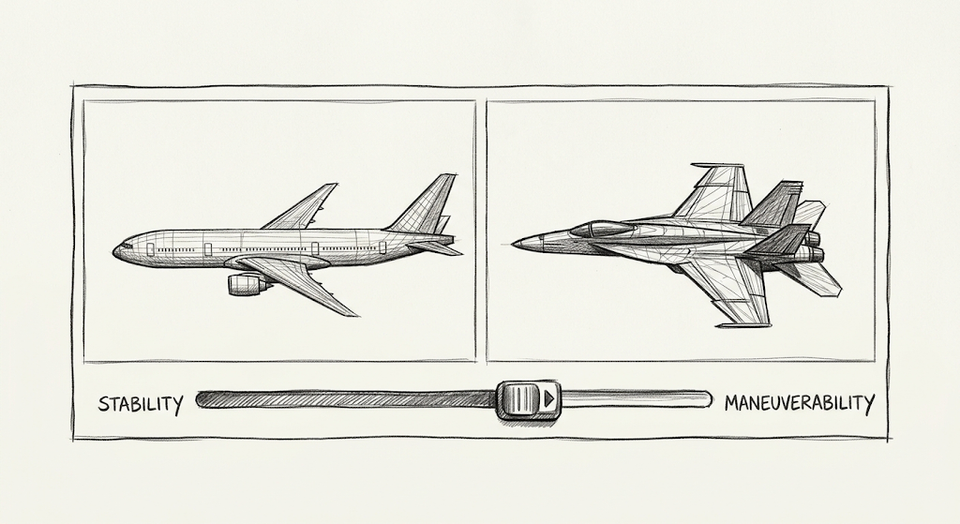
The Dogma Pendulum
The Rational Unified Process (RUP) once advocated for over 100 distinct documentation artifacts. Software engineers—a freedom-loving group requiring little capital beyond a laptop and an internet connection—naturally revolted. They swung the pendulum hard toward working software, giving rise to Agile frameworks like XP, Lean, Scrum, and Kanban.
Fresh computer science graduates read these manifestos and conclude that documentation is dead, client chats solve everything, and the Project Manager is a bureaucratic parasite to be excised. It sounds idyllic.
Now for the reality: process mechanics must adapt to project context, not to methodology dogmas.
The Control vs. Stability Dilemma
In aircraft design, stability and maneuverability are fundamentally opposed. A commercial airliner is built for extreme stability; it glides smoothly, but changing heading requires miles of airspace. A modern fighter jet is built for extreme agility, rendered intentionally aerodynamically unstable so it can turn on a dime. However, without a fly-by-wire computer making thousands of micro-corrections a minute, the jet instantly spins out of control.
Software projects face the exact same trade-off. Extreme stability (heavy Waterfall) makes changing direction painful and expensive. Extreme agility (dogmatic Agile) allows rapid turns, but without structural controls, the project disintegrates.
To balance stability against maneuverability, your operational setup must explicitly govern seven variables:
- Iteration Frequency & Flexibility: A single-iteration project is mathematically the cheapest and fastest—think of an unguided rocket. Aim, fire, and inspect the impact site when it lands. Granting the client real-time steering mechanisms increases agility, but it compounds operational overhead through continuous regression testing, deployment builds, and environmental maintenance.
- Knowledge Repository & Format: Information must be non-contradictory, accessible, and up to date. A well-maintained Wiki remains the gold standard. User stories move from issue trackers into production, eventually settling into the Wiki as living documentation. The primary metric for documentation quality is simple: Can a new engineer onboard using only the Wiki?
- Source Control & Governance: Define early where repositories live, how concurrent edits merge, backup redundancy, and client access boundaries. Establish clear coding conventions, variable naming rules, and architectural patterns to prevent code base decay.
- Workflow Visibility: Build adeqaute transparency for engineers, leads, and clients. Whether using physical sticky notes on a whiteboard or enterprise tracking software, the board must make current work and bottlenecks immediately obvious.
- Communication Cadence: Meeting frequency is inversely proportional to documentation clarity. The stronger your written single source of truth, the fewer emergency sync meetings you need to run the team.
- Reporting & Financial Alignment: Work must map to measurable units—whether story points, feature modules, or upfront fixed scope (the highest risk model). Reports exist to focus execution, not to generate a parallel universe of fictional status updates or administrative bloat.
- Client Contact Boundaries: In an ideal setup, engineers speak directly with all client tiers—from sponsors down to field operators. When direct access creates noise or disruption, Business Analysts, Product Managers, or Product Owners step in as protocol translators.
The Three Baseline Rules
No matter which methodology you deploy, govern your process with three rules:
- No unagreed changes: Never alter process mechanics without explicit team consensus.
- Justify every adaptation: Never adopt a tool or ritual simply because "everyone else is doing it" or because it sounds fashionable.
- Plan continuously, adapt fluidly: Plans are mandatory to map capacity, dependencies, and delivery dates. But plans are drawn in pencil, not carved in granite.