Chapter 38: Scaling Capacity
The Growth Imperative and the Bus Factor
Henry Ford once noted that an unexpanding business is merely a decaying one waiting for its next cash injection. While modern boutique firms champion staying small, industrial project management operates on a different law: stagnation is structural decay. To expand your own capacity as a manager, you must systematically offload your current skills and operational tasks to the next tier of talent.
Relying on irreplaceable "craftsmen" is an existential risk. Consider the old factory story of the master metalworker who could shape sheet metal with a hand hammer purely by feel. For years, he commanded exorbitant wages because no machine or engineer could replicate his touch. But eventually, hydraulic molding presses and standardized metallurgy arrived from the institutes. His leverage vanished overnight.
Tribal knowledge is a temporary monopoly, not a sustainable strategy. If your project relies on a single genius while surrounded by an unequipped team, your "Bus Factor" is 1. If that expert gets sick, burnt out, or hired away, the project collapses. Knowledge must be institutionalized and distributed.
Build vs. Buy: The Cost of Entrenched Habits
When scaling a team, managers face a choice: buy external senior talent or build internal capacity.
- Buying External Seniors: Fast ramp-up, but comes with high market premiums and "entrenched cognitive inertia." Senior hires often bring rigid habits and legacy biases from previous environments that are nearly impossible to unlearn.
- Growing Internal Junior Talent: Requires initial mentoring bandwidth, but yields team members tailored to your exact operational mechanics. Early-career engineers lack fixed zones of comfort; they respond rapidly to directional coaching and structured feedback.
Calibrating Task Friction: The Sand Driving Principle
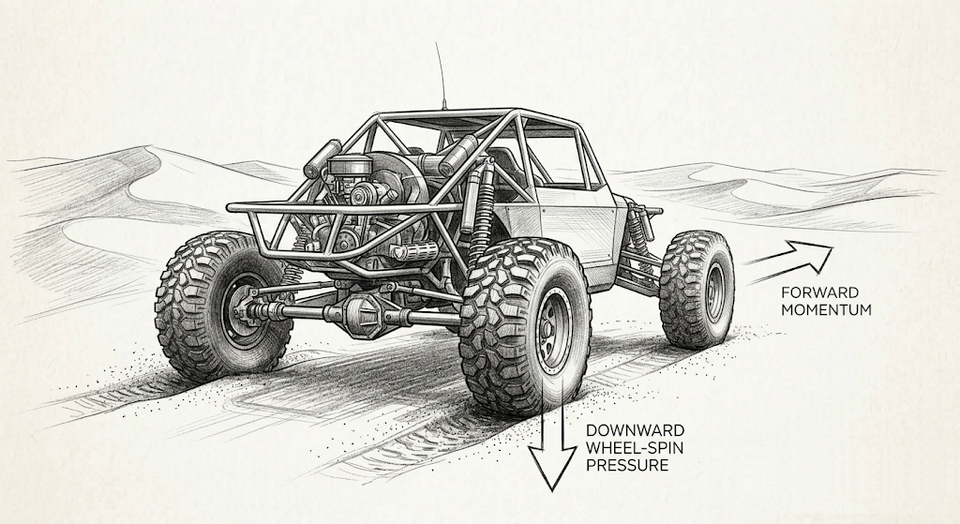
Training engineers is identical to driving an off-road vehicle across loose sand. Success depends entirely on throttle control:
- Over-Gassed (Tasks Too Complex): Giving a learner a problem far beyond their current capability causes the wheels to spin uncontrollably. The vehicle digs itself into a pit, resulting in anxiety, paralysis, and total loss of interest.
- Under-Gassed (Tasks Too Trivial): Assigning pure repetitive labor causes momentum to stall out. The vehicle quietly sinks into the sand, leading to boredom, demotivation, and passive disengagement.
- Calibrated Throttle (The Zone of Growth): Setting the difficulty just at the edge of the learner's current capability maintains traction. The vehicle glides over the terrain, driving steady skill acquisition and high engagement.
Pacing for Different Profiles
Different engineers require different surface calibrations:
- The 80% Majority: Require a carefully balanced throttle. Increase task difficulty incrementally to maintain traction without burying the vehicle.
- Adrenaline Seekers (High-Variance Performers): Thrive on high friction. Standard tasks bog them down; they require complex, high-risk problems that force rapid adaptation.
- Stabilizers (High-Routine Performers): Require predictable terrain. They deliver maximum value when executing structured, low-variance workloads with clear boundaries.
As a manager, your job is not to drive the vehicle for them, but to read the terrain, gauge the sand, and adjust the throttle until the team moves forward under its own momentum.