Chapter 46: Three Traps of Customer Discovery
Trap #1: The Ego Trap ("I Know My Client")
The most dangerous words in product management are: "I’ve been in this industry for twenty years; I know what the client needs."
Consider a simple test: you have lived with your spouse for a decade. Walk into a restaurant tonight and order her meal without asking her. In nine cases out of ten, the food will be returned with indignation.
If we cannot reliably predict the immediate appetite of the person we share a life with, assuming we can predict the behavior of thousands of anonymous software users based on "seasoned intuition" is pure hubris.
Trap #2: The Survey Trap ("Just Ask Them")
When teams realize their intuition is flawed, they run to the opposite extreme: running user surveys and focus groups. "We'll just ask them what they want!"
Back to the restaurant. You ask your spouse what she wants. She looks at the menu and orders a light green salad—declaring her intention to eat healthy. The food arrives. Two minutes later, she is reaching across the table eating fries directly out of your plate because "you eat them so enjoyably!"
When questioned, a cascade of rationalizations follows: "I didn't know I wanted fries," "I didn't want to seem greedy," "I thought the salad would be bigger."
This is the classic divide between Declared Preferences (what people say to look good, polite, or economical) and Revealed Preferences (what people actually do when faced with immediate choices). Surveys measure aspirational self-image; product success depends entirely on observed behavior.
Trap #3: The Cat Box Paradox (Buyer vs. User)
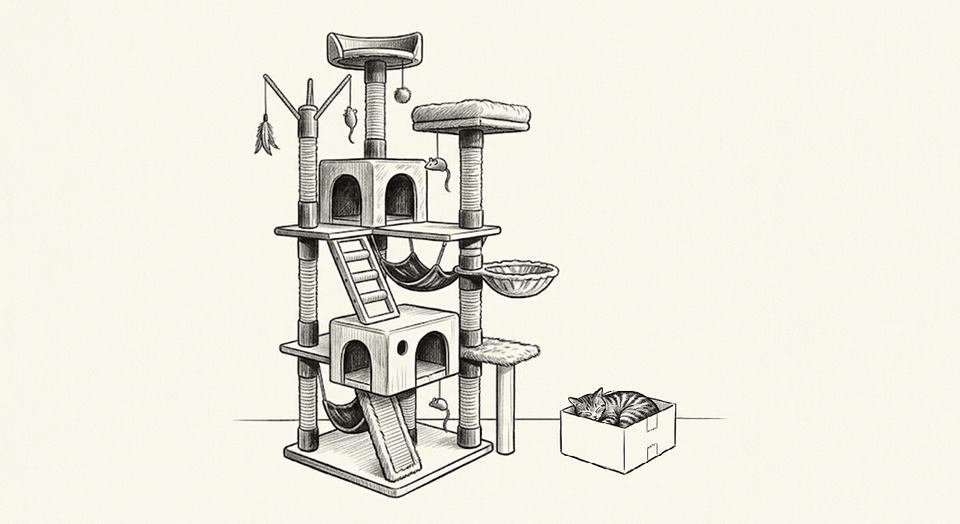
You spend €1,500 on an elaborate, multi-tiered luxury cat tower. It arrives in a plain Amazon shipping container. You unpack it, set it up, and turn around—only to find the cat sleeping happily inside the empty Amazon box.
In enterprise software, this visual plays out daily:
- The Buyer (The Parent / The Cat Owner): The CFO or VP who signs the check. They care about shiny executive dashboards, compliance checklists, and corporate positioning.
- The End User (The Child / The Cat): The line operator, developer, or support agent. They care about speed, keyboard shortcuts, and getting their job done without friction.
Building a product exclusively for the Buyer results in bloated "shelfware"—expensive systems that executives purchase, but floor workers actively bypass in favor of spreadsheets, sticky notes, or raw scripts (their equivalent of the cardboard box).
Navigating Discovery: Watch the Friction, Not the Feedback
Effective customer discovery does not rely on static interviews or feature wishlists. It requires observing how users navigate real-world friction:
- Discount Verbal Statements: Treat interview answers as hypotheses, never as requirements.
- Observe Revealed Behavior: Build quick, low-fidelity experiments ("smoke and mirrors") to see what users actually click, buy, or reach for.
- Map the Buyer-User Split: Ensure the purchasing decision satisfies the buyer's criteria without destroying the daily ergonomics required by the actual end user.