Chapter 47: Bridging Business and Architecture
The Photo vs. Video Paradox
Software engineering demands precision: to write executable logic, an engineer needs a stable snapshot of requirements—a photo.
Business, however, exists in a continuous, turbulent video stream. Markets shift, regulators change rules, competitors pivot, and customer preferences evolve overnight.
The fundamental conflict between product management and engineering stems from this mismatch. Managers live in the video stream; developers demand a photo. The role of a pragmatic product manasger is not to pretend the video stream has stopped, but to calibrate how often—and how deeply—to take the next photo.
Volatility Profiling: The Cost of Freezing Specifications
The demand for a "100% frozen specification" is an engineering instinct, but enforcing it without context is a strategic error. The required rigidity of a system is a direct function of its domain volatility:
- Low Volatility (High Stability): Medical devices (e.g., cardiac pacemakers) require exhaustive specifications, multi-tier regulatory sign-offs, and rigid safety audits long before production. Changes are rare, slow, and enormously expensive.
- High Volatility (Rapid Evolution): Early-stage fintech or AI-driven middleware platforms exist in hyper-dynamic markets. Here, the core product hypothesis may be rewritten ten times before finding product-market fit.
Attempting to apply pacemaker-level specification freezing to a high-volatility product guarantees wasted engineering hours on features that will be discarded next month.
The Section Cut: Isolating Invariants from Hypotheses
In structural mechanics, when calculating stress on an airplane wing, engineers do not attempt to compute every molecular interaction at once. They perform a "section cut"—isolating a specific structural boundary and calculating the exact forces acting upon that plane.
Architects and product leaders must perform the same section cut on software systems:
System Domain = Core Invariants (Static) + Market Hypotheses (Volatile)
- Core Invariants (Inside the Cut): The foundational mechanics that rarely change (e.g., sensor telemetry cycles, transaction atomicity, core data models). These demand modular, robust architecture.
- Market Hypotheses (Outside the Cut): UI flows, pricing tiers, integration channels, and temporary features. These require elastic, decoupled interfaces designed to be rewritten or purged without tearing down the core foundation.
Scouting the Fog of War
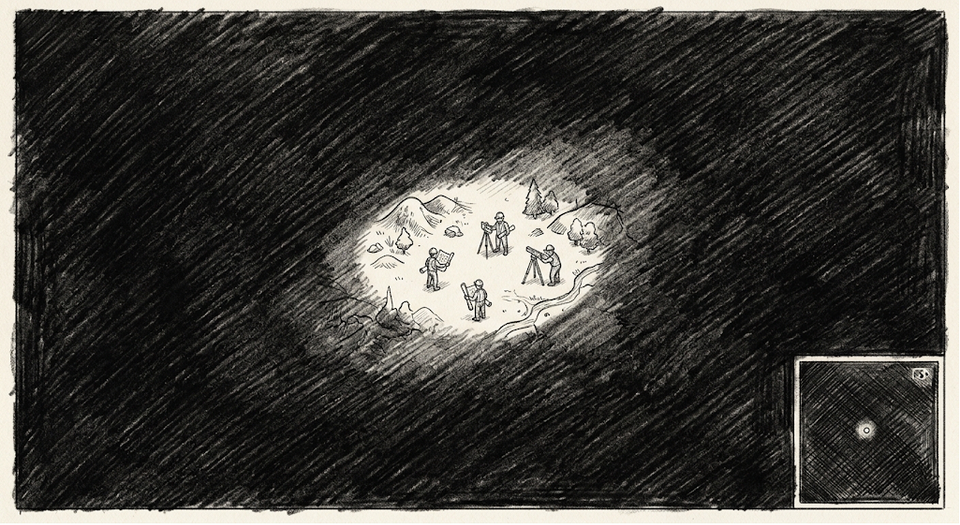
When engineering teams refuse to start building until the entire system roadmap is fully mapped, use the Real-Time Strategy (RTS) gaming analogy:
You start the game with a single worker unit and a tiny visible map area surrounded by dense Fog of War. You construct your first buildings based on the terrain you can see right now. As your scouts explore the perimeter, you discover that what looked like an open ocean is actually an impassable mountain range—invalidating your plan to build a naval port.
Requiring a 100% frozen specification before writing code is the equivalent of demanding that the entire map be revealed before moving your first unit.
The same logic applies to technology stacks. Mature teams do not adopt bleeding-edge frameworks for the sake of novelty ("Stack Wars"). They select a baseline stack capable of handling the immediate, visible terrain—and adapt their tooling only when the Fog of War uncovers a concrete, undeniable structural barrier.