Chapter 52: The Synthetic ROI Matrix
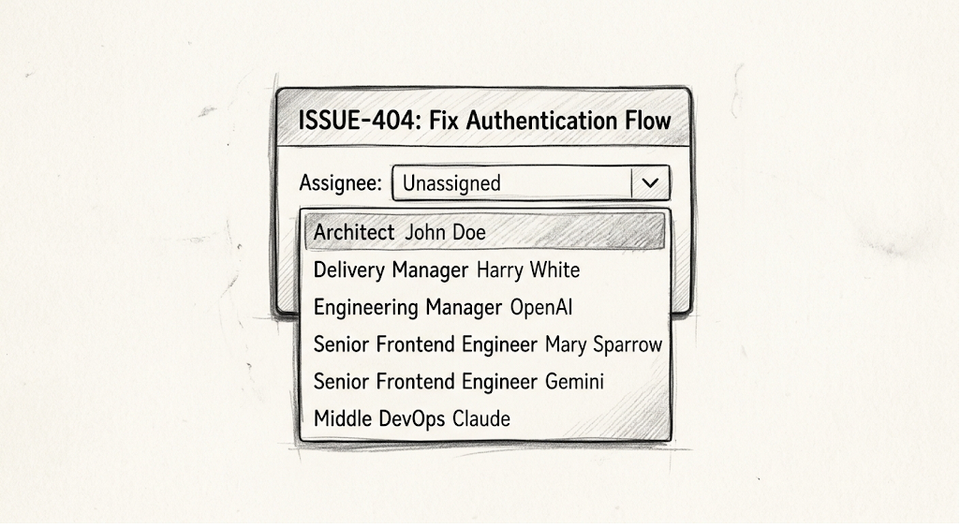
The Anti-"Basism" Principle: Beyond Carbon vs. Silicon
Modern corporate HR and management frameworks are rightfully vigilant against sexism and ageism. Yet, as generative models enter the workforce, a new cognitive bias may emerge in engineering management: Basism—the discrimination against execution based on its underlying substrate (biological carbon vs. synthetic silicon).
In a mature product organization, "basism" is an expensive mistake.
Evaluating a technical contribution based on whether it was typed by a human mind or synthesized by an LLM is a return to the Fallacy of the Standalone Craftsman. Just as a master artisan producing flawless code for a feature nobody wants yields zero business value, an expensive frontier model generating elegant algorithms in a vacuum is pure operational noise.
Accountability, delivery, and business alignment are substrate-agnostic. The true unit of valuation in modern engineering is not the standalone engineer or the standalone model—it is the Synthetic Execution Unit (Human Context + AI Execution Capacity), evaluated strictly by its ability to drive the company’s Value Delivery Chain.
The Airline Paradox in the Synthetic Era
As established in Chapter 44, technical skill is relative to business context. The contrast between Singapore Airlines and Ryanair provides the exact economic blueprint for configuring your AI stack:
- The Singapore Airlines Model (High-Touch / Human-Centric Augmentation): If your Unique Selling Proposition (USP) relies on luxury service, high-touch care, and deep customer trust, replacing your front-line human interface with an autonomous GenAI bot is a brand-destroying mistake. A luxury concierge experience cannot be simulated by a probabilistic model that lacks genuine biological empathy and situational intuition.In this model, ROI is achieved by placing empathetic humans at the front, backed by synthetic intelligence behind the scenes. Human support agents interact directly with the client, but use specialized AI agents and RAG systems as internal cognitive force-multipliers. The human remains the ultimate quality gate—aware of the model's limitations, filtering out hallucinations, and translating synthetic data into a seamless human experience. You willingly absorb higher human payroll costs because trust and empathy are the core engines of your premium margin.
- The Ryanair Model (Extreme Cost Reduction / Autonomous Self-Service): If your USP relies on lean margins, hyper-efficient self-service, and absolute cost reduction, paying human personnel to handle routine customer interactions is operational failure.Here, ROI comes from placing autonomous AI agents at the very front line. Customers interact directly with a synthetic interface that answers queries, resolves standard tasks, or routes users directly to knowledge base articles for self-resolution. Any minor friction or occasionally rigid interaction is an acceptable trade-off within a low-cost, self-service expectation baseline.
Neither stack configuration is inherently "better"—its ROI is strictly calibrated to the company's core promise to the market.
The Synthetic System Multiplier
In traditional engineering, high-value senior staff transcend their individual output by serving as System Multipliers—reducing Bus Factor, coaching junior talent, and suppressing cross-departmental friction.
In a hybrid organization, the Synthetic Execution Unit amplifies these exact leverage points:
- Bus Factor Reduction: Instead of domain knowledge remaining trapped inside a senior engineer’s head, it is codified directly into the repository’s Spec-Kits and Harness guidelines. The synthetic system acts as a living, executable knowledge base.
- Accelerated Onboarding: A junior engineer backed by a Level 1 AI Assistant doesn't waste weeks deciphering tribal legacy code; the agent provides real-time contextual navigation within defined guardrails.
- Eliminating Cross-Departmental Drift: By using Generalist models at Level 2 Delegation to translate product requirements directly into architectural specs, misalignments between product management and engineering execution are resolved before code generation begins.
The Pragmatic Valuation Matrix
To calculate the real ROI of your AI transformation without building a bloated token-accounting apparatus, measure three core delivery indicators:
- Cycle Time to Validated Output: The wall-clock time required to move from a validated Spec-Kit to a working feature in production (or a discarded Disposable Code test).
- Defect Leakage Rate: The percentage of synthetic artifacts that breach CI/CD guardrails and require manual intervention from a human architect.
- Token-to-Outcome Ratio: Evaluating compute expenditure strictly against business milestones delivered, ensuring engineers aren't running expensive frontier models on low-leverage syntax tasks.
When you eliminate "basism" and calibrate your synthetic stack directly to your business model, AI stops being a speculative expense line item—it becomes a precise, predictable engine of enterprise value.