Chapter 51: Multi-Agent System Steering & Synthetic Delegation
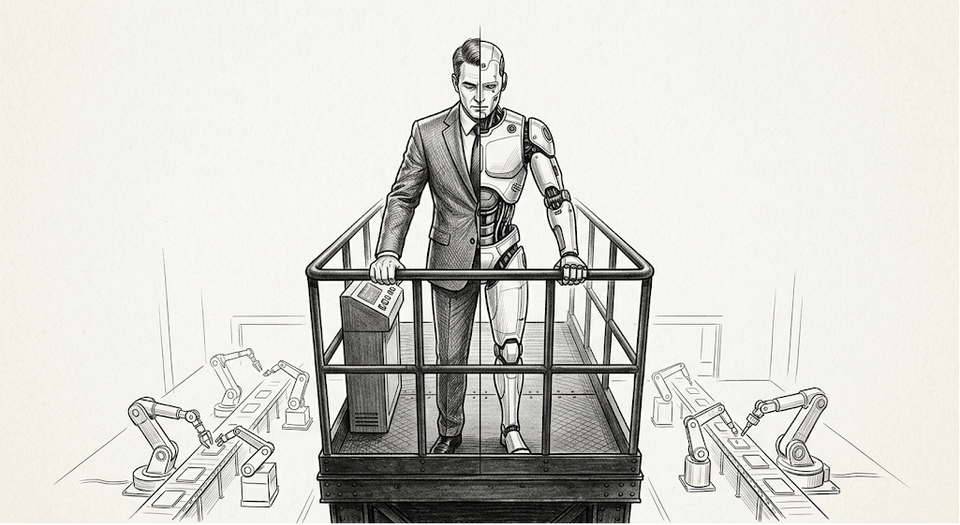
The Architecture of Dual-Level Delegation
As product organizations integrate GenAI into the core execution pipeline, team structures evolve from single-point prompt generation into multi-layered agent orchestration. Managing this synthetic workforce requires understanding two distinct operational tiers:
Level 1 Delegation:
Engineering Manager -> Developer = Engineer -> GenAI Agent
Level 2 Delegation:
Delivery Manager -> Engineering Manager -> Developer = Engineer -> General GenAI Agent -> Specialized GenAI Agent
- Level 1 (Technical Context Transfer): The individual engineer delegates syntax generation, boilerplate writing, and unit-test creation to a local AI assistant. The engineer acts as the immediate quality gate, passing precise technical constraints and validating code output line-by-line or function-by-function.
- Level 2 (Management Context Transfer): The Engineering Manager or Architect delegates strategic sub-domains to an engineer, who in turn orchestrates a network of specialized AI agents. Here, the manager is not transferring syntax requirements; they are transferring operational intent, strategic boundaries, and business goals.
If Level 1 is about getting a single function written, Level 2 is about maintaining system coherence across an entire product module.
The Farmers Market Principle in Agent Orchestration
Recall the delegation framework from Chapter 25: A grandmother needs soup ingredients from a local farmers market near closing time.
If she provides a rigid, micro-managed instruction list ("Buy broccoli"), the task fails the moment the broccoli vendor closes shop. If she delegates the problem frame ("Go to the market, see what vendors are open, and suggest two soup options we can prepare by 16:00"), the executor turns into an active decision-making agent. He surveys field conditions, analyzes constraints, and reports back actionable context: "We can make tomato soup or lentil soup; broccoli is sold out."
This is Synthetic Delegation.
Instead of treating an AI agent as a dumb script executing step-by-step commands, high-leverage engineers delegate the problem space within explicit bounds. The generalist model evaluates available domain tools, assesses input data, and presents structured execution options before burning compute on full implementation.
Model Specialization: Generals vs. Specialized Troops
To execute synthetic delegation efficiently, organizations must match the cognitive profile of the AI model to its role in the pipeline.
- Frontier Generalist Models (The Architects & Managers): Models with massive context windows, deep reasoning capabilities, and broad cross-domain knowledge (e.g., Claude Opus, GPT-4o). These models do not need hyper-specific fine-tuning for every niche framework. Their primary value lies in breadth of context—understanding when, why, and how to invoke specialized tools and sub-agents.
- Specialized Niche Models & SLMs (The Execution Specialists): Compact, fast, domain-specific Small Language Models trained exclusively on localized tasks (e.g., SQL generation, code linting, specific API mapping). They operate at low token cost with lightning execution speeds.
In a mature multi-agent architecture, a Generalist model acts as the project lead. It receives the high-level Spec-Kit from the human architect, breaks down the workload, delegates sub-tasks to specialized SLMs, collects their outputs, and verifies cohesion before presenting the final pull request to the human reviewer.
The Fallacy of Biological Common Sense: Kahneman vs. GenAI
A common objection to multi-agent autonomy is the assumption that human engineers possess "inherent common sense" while AI models blindly hallucinate.
This assumption overestimates human rationality. Nobel laureate Daniel Kahneman demonstrated that human decision-making is heavily driven by System 1 heuristics—fast, emotional, intuitive leaps based on the Availability Heuristic (relying on immediate examples that come to mind).
When a rushed human engineer makes a critical architectural decision based on the last framework they read about, they are relying on cognitive bias. When an AI model generates a non-existent API method, it is relying on probabilistic token weights.
- The Human Mechanism: System 1 availability heuristics and cognitive fatigue.
- The AI Mechanism: Probabilistic hallucinations and context window decay.
- The Business Result: Identical. The team is served a bowl of poisonous mushroom soup.
Neither biological nor synthetic intelligence can be granted unbounded autonomy. Autonomy without physical boundaries is operational negligence.
Synthetic delegation only functions when execution is confined to a strictly defined Sandbox. The human architect provides the non-negotiable guardrails (the Spec-Kit, repository rules, CI/CD security checks, and operational invariants). Within those walls, the multi-agent system has total freedom to explore, adapt, and propose solutions. Outside those walls, execution is hard-blocked by automated gates.