Chapter 03: The Balance Guideline
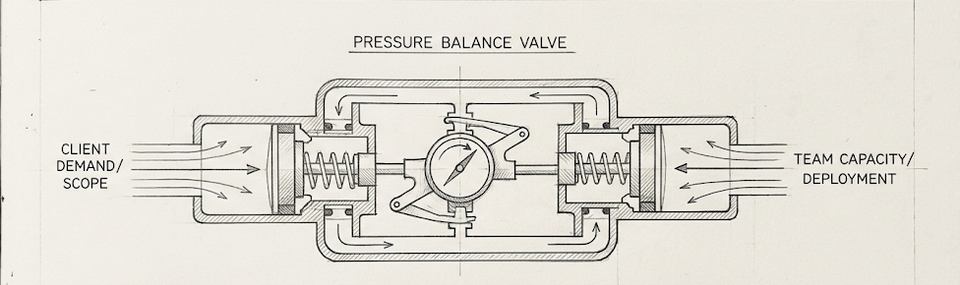
The Savior Complex
Power and authority change people—rarely in the ways they expect. When a top technical specialist is promoted to management, they often enter the role driven by a savior complex.
They look back at their predecessor with quiet disdain: "Why was the previous manager always arguing with the client, pushing back on scope, and refusing early deliveries? Why did they reject Joe’s brilliant architectural refactoring idea? Everything is going to be different now."
The new lead resolves to be the ultimate accommodator. They default to total agreement, never say no, and use their own technical prowess as the ultimate shock absorber. If a deadline tightens, they work extra hours. If a developer gets tired or abandons a task halfway through, the lead quietly steps in and finishes it.
This accommodating strategy works seamlessly—right up until it triggers a total operational collapse.
The Thursday-to-Monday Spiral
The breakdown follows a predictable, battle-tested sequence:
- Thursday: Driven by a desire to impress, the manager promises the client a critical bug fix by Monday morning. The task requires four full days of focused engineering.
- Friday: The lead developer asks for a day off. Incapable of setting boundaries or saying no, the manager approves the leave.
- The Weekend Crunch: Realizing there are four days of work left and only two days remaining, the manager pulls emergency 12- to 14-hour weekend shifts. Exhausted and rushing, they leave unverified debug code scattered across the repository to force a passing build.
- Monday Morning: The developer returns, reviews the commits, and is horrified. The clean architectural logic they built over six months has been hacked apart. Rolling back Version Control System history will destroy two days of work and delay shipment by three days.
- The Deployment: The team ships the code as-is. The client immediately encounters glitched behavior and demands a contractual discount for irresponsible delivery.
The exhausted manager arrives at the office operating on zero sleep. First, the developer berates them for ruining the codebase; then, the client attacks them for delivering amateur work.
Compounded by sheer fatigue, the lead snaps. They transform into a monster—yelling at the developer, imposing draconian penalties, escalating with the client, or threatening to resign on the spot. Alternatively, they retreat into quiet self-loathing, silently absorbing more tasks until they hit a destructive boiling point.
Heroics Are Diagnostic Alarms
Trying to please everyone simultaneously is a direct route to operational failure. The fundamental flaw in the savior approach is mistaking heroics for good management.
When an engineering team is forced to act heroically—staying late, fixing broken builds repeatedly, or waking up at 3:00 AM to patch a crashed production server—it is never a victory. Heroics are a diagnostic alarm indicating systemic failure upstream.
A manager is not a martyr or a technical safety net. A manager is an operational coordinator enforcing systematic rules of engagement. When a manager fails to establish boundaries, they inevitably regress into one of three degenerate organizational roles:
- The Punching Bag (Doormat): Regardless of who breaks process, the manager absorbs 100% of the executive and client gunfire while shielding everyone from accountability.
- The Magic Wand: Developers write dirty code or miss commitments, knowing the manager will magically swoop in over the weekend to convert technical debt into working software through personal sacrifice.
- The Volcano: A person who stays quiet, absorbs endless operational friction without giving feedback, and periodically explodes without warning—before returning right back to broken defaults.
The Governance Protocol
A manager is not a $100 bill—you cannot, and should not, attempt to please everyone. Sustainable delivery velocity requires transparent governance, clear operational boundaries, and predictable accountability:
- Enforce Consequences and Rewards: Non-performance must carry immediate, predictable consequences based on pattern frequency. Over-performance (delivering higher quality, faster, or cleaner) must receive immediate, tangible recognition.
- Never Absorb External Accountability: Never do your team's work for them to compensate for poor discipline or missed commitments.
- Maintain the Rules of Engagement: Your core duty is ensuring everyone plays by the agreed-upon system rules, protecting the engineering pod from chaotic external scope while holding the pod strictly accountable to commercial commitments.