Chapter 40: The Cookbook Trap
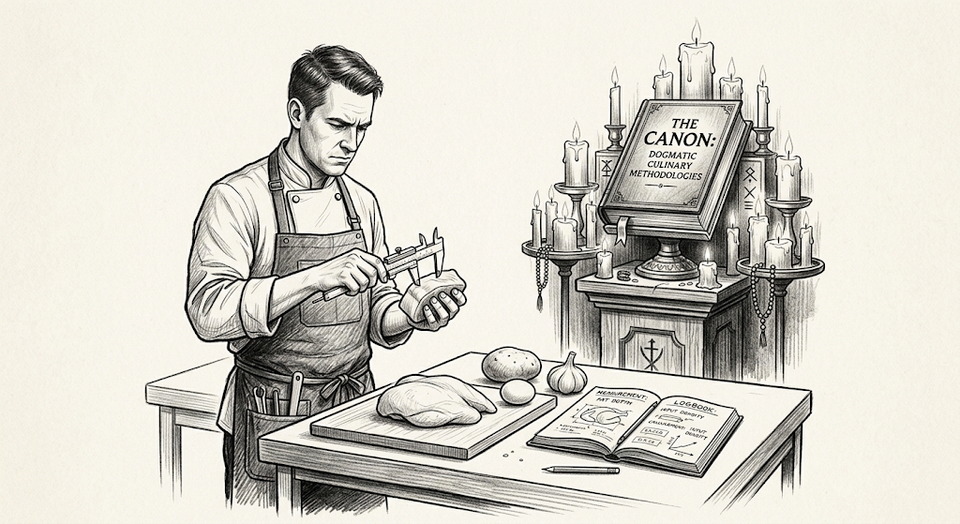
The Silver Bullet Delusion
Few management urges are as pervasive—or as destructive—as the desire to import a methodology wholesale. "We just need to read book XYZ, adopt their framework, and our operational chaos will vanish overnight."
This is the classic confusion between necessary and sufficient conditions:
- Necessary: Reading the book and understanding the mechanics of a framework.
- Sufficient: Adapting, modifying, or discarding parts of that framework to fit the brutal realities of your specific domain.
A methodology is merely a record of what worked for someone else, somewhere else, under a specific set of constraints. Treating a management book as a plug-and-play script is not leadership; it is an evasion of original thought.
Context Trumps Frameworks
Frameworks applied out of context produce absurdity. The ideal agricultural process for growing tomatoes in the Arctic circle will not optimize patient care in a maternity ward.
Yet in software engineering, we witness this exact mismatch daily. Applying pure, lightweight Agile iterations (Scrum/Kanban) to life-support systems on a space shuttle is negligence. Spacecraft engineering demands strict, pre-execution specification, massive documentation, and zero-tolerance safety audits. When the cost of failure is loss of life—or when structural payload weights are non-negotiable—"failing fast in production" is not an option.
Before adopting any trend, ask a fundamental question: Do our domain constraints match the constraints under which this methodology was created?
Cookbook Management vs. Executive Chef
Treat management literature the same way a master chef treats a cookbook.
- The Novice (The Dogmatist): Reads a single recipe for dumplings and immediately forces it onto every customer. When a diner orders a delicate miso soup, the novice serves them half-cooked dumplings anyway—insisting it is the modern, correct way to eat.
- The Master Chef (The Pragmatist): Possesses a deep library of recipes, understands the fundamental chemistry of heat and ingredients, and evaluates the specific customer order before touching a knife.
Every experienced practitioner eventually develops an itch to write their own definitive blueprint for how everyone else should live and work. (Writing this book is proof the itch is contagious). The secret is recognizing that no book—including this one—can substitute for real-time situational judgment on the kitchen floor.